
INTRODUCTION: Like many Americans, I suspect, I grew up quite ignorant about my family’s ancestry. Partly this was due to what appeared to be indifference on the part of my parents, and partly it was the result of the itinerant lifestyle dictated by my father’s career as a U.S. diplomat. My sister, brother, and I were all born outside the U.S., and my father’s continuous postings overseas meant visits with extended family members were infrequent at best. Our grandmothers were distant, if kindly presences, but I knew my paternal grandfather only fleetingly, and my maternal grandfather, who died a decade before I was born, not at all.
My paternal grandfather, Paul Carle, died in 1961 when I was five years old. Though I was too young to be able to understand who he was outside of his relationship to me, or perhaps because of that, I mourned his absence keenly throughout my childhood. I remembered a gentle, warm, and loving presence, and I carefully nurtured the handful of memories that I had of him. As I got older, I came to understand that he died prematurely, aged 67, of lung cancer, and this heightened my sense of loss. My father did the best he could to assuage that with stories about the dad he loved dearly, painting a picture of a happy childhood and family life in his hometown of Coronado, California. I used those stories to embellish my recollections, weaving them into a narrative that transformed the man I had barely known into an invincible mythical hero and protector who I imagined was watching over me from some perch in heaven.
It didn’t occur to me to ask my father about Grandpa Paul’s parents until I was in my early teens. I remember it as a time when I was straining to construct a façade of the “cool” that teenagers of my generation aspired to. I hadn’t yet mastered the detachment and feigned indifference about family matters affected by many of my peers, so couldn’t hide the shock I felt at my father’s answer. He told me that Grandpa Paul’s parents weren’t married, and that he didn’t know who Paul’s father was. Grandpa Paul had never spoken to his sons (my father and my Uncle Tom) about his father, and whatever he knew, he carried to his grave.
“You mean Grandpa Paul was illegitimate?” The question reflected the social mores of the time. I didn’t know much, but I had absorbed the lesson that then, unmarried parents were considered scandalous.
My father nodded, adding, “When I was growing up, sometimes when my mom was mad, she’d call my father a bastard, and I always understood that she meant it literally.”
I was both saddened and indignant. My grandmother had insulted my cherished hero. “She called Grandpa Paul a bastard? That’s terrible! But why? It’s not fair! It wasn’t his fault…” My tone rose, seeking reassurance from my father.
“No, of course not,” he responded. “But in those days, people had different ideas and my mother felt ashamed, so she blamed my dad.” My father shrugged philosophically, and I retreated to my bedroom to process what I’d just learned.
Following my father’s lead, I decided I wouldn’t dwell on the moral opprobrium that my poor grandfather had faced over the circumstances of his birth, though it pained me to consider how hurtful it must have been. I realized, however, that Grandpa Paul’s parentage did matter to me. His father, whomever he might have been, was my great-grandfather. Who was he? Where did he come from? How could I know who I was if I didn’t know who he was?
It wasn’t until I was much older, however, after I’d had children of my own, that such questions prompted me to buy a guide to family history research and begin systematically looking for answers.
It took me 25 years to find my great-grandfather. And I might never have found him, if it hadn’t been for a desperate act by my great-grandmother in 1894 that landed on the front pages of newspapers of the day. The family didn’t know about it because the sensational reporting lasted only several weeks and the main characters moved to other towns, the matter faded from public memory, and accounts of the scandal were consigned to inaccessible institutional archives. There they might have crumbled into dust were it not for dedicated historians and librarians and the development of the technologies of microfilm and digitization, which rescued untold numbers of disintegrating old documents and put them within reach of anyone with a computer.
So it was that nearly 120 years later, in July 2012, I typed my great-grandmother’s name – Louisa DeWitt Carle, née Bannse — in the search bar of a website hosting a growing collection of digitized historical newspapers. Hoping that old newspapers might turn up if not the answers I was seeking, then at least one or two helpful clues, I had taken to checking online historical newspaper sources for mentions of my great-grandmother whenever an opportunity presented itself.
Up to that point, every search had the same result: 0 records available. But since more and more old records were being digitized each year, I persisted hopefully. And finally, on that July morning, a weary tap of my laptop’s return key yielded two newspaper articles datelined Tacoma, Washington, December 14, 1894.
I was utterly dumbfounded after reading the first article’s opening two sentences. After decades of dead-ends and brick walls, suddenly I had more information than I knew what to do with. Far from being a secret, the name of Grandpa Paul’s father was announced in newspaper headlines. And the tsunami of questions flooding my brain told me I was no wiser than before.
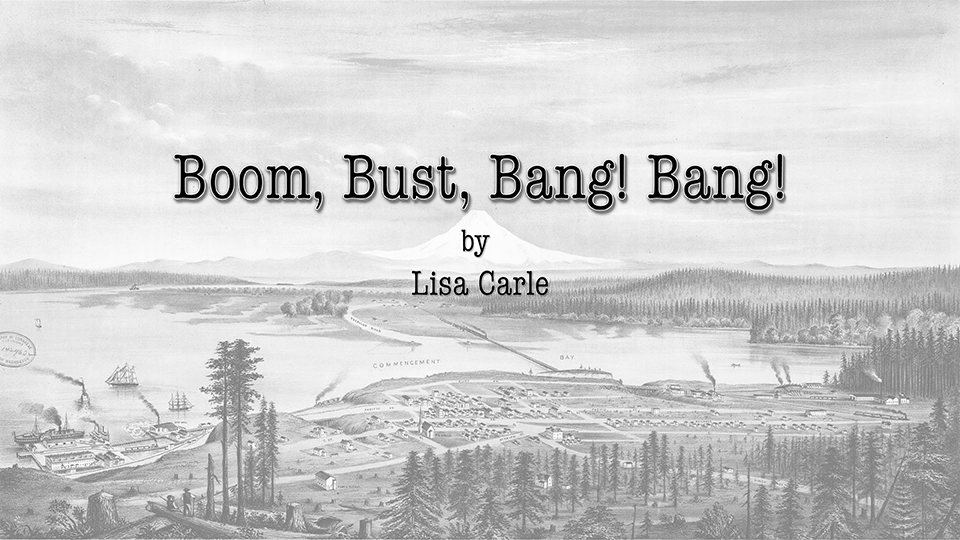
It took me almost another decade to sort out what happened, to the extent that we can ever really understand the past. I discovered a story whose roots were entangled in the development of Tacoma, Washington. Dubbed a “City of Destiny” during the 1880s, Tacoma could be called a poster child for both the excesses of the Gilded Age in which it was spawned, and the “Hard Times” which followed the Panic of 1893. I found a story not only about my father’s family, but about human folly and the relentless greed, brutality, and violence embedded in our national history. Ultimately, however, I found a story about survival through persistence, love, and resilience. My video, Boom, Bust, Bang! Bang! is excerpted from my upcoming book of the same name, and I offer it in tribute to my beloved grandfather, and to survivors everywhere.
